
How to Use a Reverse Chronological Resume Format
Get a Free Expert Review14 min read. Updated on November 10, 2025

Ronda Suder
Career Expert

Everything you need to know about writing a chronological resume
For many professionals, a chronological resume is the most effective format for capturing skills, experience, and achievements. That's because this resume format focuses on the employment history section, which provides ample space to explain the candidate's career trajectory.
The chronological resume format is also what recruiters and hiring managers prefer to see and is the most easily read by an employer’s applicant tracking system (ATS). As a result, using an alternate structure could decrease your chances of landing the job.
To keep that from happening, you need to understand how to craft a chronological resume properly.
What is a chronological resume?
It's been said that past behavior is the most reliable predictor of future outcomes. Therefore, prospective employers rely on your career accomplishments to get an idea of what you can do for them. That's part of what makes the chronological resume format so popular.
The chronological resume is a format that focuses on the employment history section where work experience is listed in reverse chronological order. The main idea is to start with your most recent or current position and work backward through all your relevant experience from the past 10 years.
When hiring managers can quickly digest what you've done in the past, they are able to get a feel for whether you'll be the right candidate for their team. By focusing your career history on the most recent experiences and working backward for approximately 10 years, you provide the most up-to-date and accurate representation of what you bring to the table in terms of accomplishments and skills.
What’s the difference between a chronological resume and a reverse chronological resume?
As you research resume types, you may come across both the “chronological resume format” and the “reverse-chronological resume format.” These terms are used interchangeably. In other words, a chronological resume is often referred to as a reverse-chronological resume – they’re the same thing.
How to structure a chronological resume
It's critical to note that the structure of your chronological resume is just as important as the content you include in it.
How the information is laid out on the page will aid the recruiter or hiring manager – who's spending mere seconds glancing at it – to easily find the information about your career history they want. Your chronological resume will contain at least six sections, each with a relevant header.
Here's an outline of what you should include in your chronological resume:
Contact information
You want the hiring manager to contact you for an interview, right? Well, here's the place to make sure they have the details they need to do just that.
Include your name (it doesn't have to be your full legal name – just use your first and last name, or the name you go by will suffice), location, phone number, and email address.
You can also add links to your LinkedIn profile and any online portfolios you may have. Only include URLs for your LinkedIn profile or portfolio if they’re optimized and complete.
Here’s a template example:
First and Last Name Phone Number | Email Address | City, State, Zip Code | LInkedIn URL
You can also include any notable certifications or degree acronyms if they’re required for the job. For example:
- John Smith, CPA
- Rosa Jones, PhD
- Jimmy Jones, PHR
A resume headline or title
The headline grabs the reader's attention. Write a one-line blurb that contains the title of the job found in the job description, along with a couple of relevant keywords that will help you to stand out from the crowd. For example:
- Award-Winning Senior Public Relations Professional
- Results-Driven Marketing Industry HR Director
A summary or professional profile
Your professional summary is a three to five-sentence paragraph that outlines the significant events of your career. Start with something that mirrors the title in the job description and match it with the hard and soft skills you possess. Be sure to also note any required certifications you hold. Throw in at least one achievement, as well, with your level or years of experience. Here’s an example:
Results-driven Software Developer with 15 years of experience developing innovative and scalable mobile applications using Python, JavaScript, and C++. Proven success in driving positive end-user experience and optimization to achieve business goals.
Skills or Core Competencies
This is the place for a bulleted list of skills or core competencies. Include 9 to 12 skills that you have that will show the hiring manager you have what it takes to get the job done. Use the same language and keywords you find in the job description to ensure that your resume makes it past the ATS.
You can place a core competencies list near the top of your resume, just below your resume summary, or you can place it near the end of your resume, below your Education section. Some might choose to include both lists, as long as each list includes different skills or competencies. In other words, avoid redundancy between the two lists.
Let’s look at an example of what an Accountant resume might include:
Core Competencies
Certified Public Accountant (CPA) | Tax Law | Accounts Receivables | Accounts Payables | Project Leadership | QuickBooks | EofY Accounting | Employee Payroll | Joint Venture Accounting
Work experience or employment history
Now you've come to the nitty-gritty part of your resume – what you've done and when and where you did it. Keep in mind that hiring managers will look to your past accomplishments to see what you have to bring to their team. It may be tempting to dump everything you've ever done, but relevancy is critical.
Let's take a closer look at how to write this section.
Always list the name of the company you work for first. This is important because if you have a company where you held multiple roles, you can stack the roles to show progression. You need the following information as a sub-heading:
- Employer name
- Location
- Dates worked
- Job title
Then, add 4 to 5 bullet points to discuss various aspects of your time in the position. You can focus on topics like:
- Projects or tasks you completed
- Skills you used
- Awards and achievements
Ensure that you list these entries, starting with your most recent or current job and work backward, as this is a fundamental component of the reverse-chronological resume format.
Also, be sure to use lots of numbers and statistics that quantify your successes and results. Quantifiable results help employers better visualize your ability to succeed compared to a mere list of your skills or accomplishments.
To clarify this point, consider which of the following work accomplishments offers more punch:
Lead $5M pipeline improvement project with 25 contractors that resulted in $250K cost reduction.
OR
Pipeline Project Lead responsible for managing contract project team.
Education
For your education, you can (and should) include degrees and the colleges you've attended. However, don't forget about things like professional development classes, certifications, and licenses. Spell out acronyms and omit your graduation dates. Similar to your work experience, this section should be presented in reverse-chronological format. Here’s an example:
EDUCATION
Master’s of Education in Counseling | College Name | Anytown, Anystate
Bachelor of Science in Psychology | College Name | Anytown, Anystate
Certifications
Cognitive Processing Therapy Certification | PsychArmor | 2023
Related reading: How to List Education on Your Resume - With Examples
Additional sections like awards, hobbies, volunteer experience, or languages
Sometimes, there are things you've done outside of the regular workday that are also important to securing a new job. This is especially true if these activities help to fill in gaps in skills or traditional work experience.
You can create additional sections on your resume for activities such as
- Public speaking
- Special projects
- Awards
- Volunteer experience
- Hobbies
Just remember, if you're adding it to your chronological resume, it needs to be relevant to the hiring manager who will receive it. For example, if you are applying for a marketing position and volunteered to run a local charity's social media campaign, that could add value to your resume, especially if you lack traditional experience to include.
When to use a chronological resume format
The chronological resume is considered the standard resume format because it suits the widest range of professionals, including people in healthcare, IT, law, HR, business, and energy. It's especially useful if you've enjoyed a traditional and progressive career path with advancements through promotions and new jobs.
Potential drawbacks of using the chronological format
Although the chronological resume format is a popular and standard choice, largely because it’s relatively straightforward and easy to follow, it does have some drawbacks. By understanding the drawbacks, you can take steps to overcome them or choose a different format that might work better for you.
Some drawbacks of the chronicle resume format related to the chronological layout are that it can:
- Easily highlight frequent job changes, which can be a red flag for employers
- Make it easier to notice employment gaps, potentially raising employer questions or concerns
- Highlight less relevant work experience first, depending on the role you’re applying to
- Make it more challenging to highlight transferable skills for a new field for those changing careers
- Foster ageism or unconscious bias due to the focus on dates and job levels
- Overshadow accomplishments and skills due to the prioritization being on job titles, levels, and dates
- Feel redundant if you’ve held several roles with similar job duties, responsibilities, and accomplishments
- Sometimes be difficult for recent graduates to use when they lack relevant work experience
- Make it difficult to highlight a career progression for those who primarily work on projects of temporary projects
Who should not use a chronological resume?
The chronological resume is less suitable for creative or independent professions, where gig work and short-term contracts are part of the career path. It’s also not the best option for those who have gaps in employment, have frequently changed jobs, or are seeking to transition into a new career.
In such cases, alternative resume formats, such as functional or hybrid models, may be more suitable.
What is a hybrid and functional resume?
In addition to the chronological resume format, there are the functional and hybrid resume formats to choose from.
- The functional resume focuses on your skills more than your work accomplishments. It’s a good alternative for people who are returning to the workforce after an extended absence or for people who are making a major career change.
- The hybrid resume format, also known as a combination resume format, combines elements of the chronological and functional resume formats to equally emphasize your skills and accomplishments. This can be a good choice for if you have an unconventional career path and want to highlight transferable skills in addition to some relevant work experience.
Expert Tip: When a chronological format might not be the best option for you, it’s best to use the hybrid format instead of the functional format. There can be some stigma associated with using the functional resume format. In rare instances should a functional format be used.
How to use the chronological resume format
Now that you know what a chronological resume is, what the outline looks like, and who should use it, let's dig into the actual writing part.
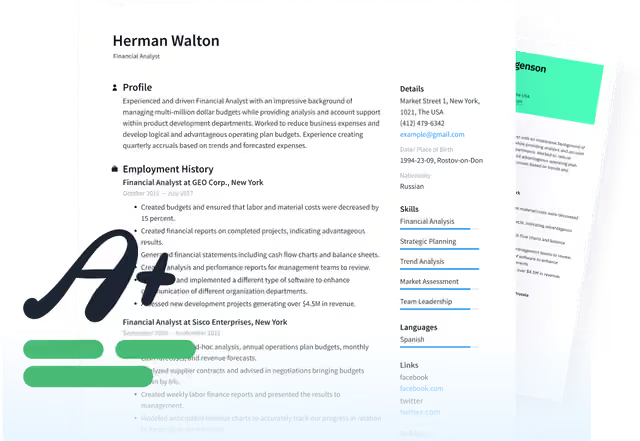
The format of your chronological resume is almost as important as the writing, because a clean and organized layout is one of the best ways to show that you're a professional and motivated candidate.
Make sure to use bold or italics to highlight the key information within your resume, including the employment history section.
Examples of chronological resumes
To get a sense of what goes into a great chronological resume, let's look at the employment history section for a customer service representative:
Customer Service Representative example
AT&T | August 2020 - Present
Customer Service Representative, Fort Worth, TX
- Handled customer calls and responded to queries about services, product malfunctions, promotions, and billing
- Worked to address all customer concerns in a timely and effective manner
- Calmly handled 200+ calls each day
- Developed successful tactics to upsell products and services to customers
- Piloted a feedback program that resulted in a 15% increase in branch sales
Server example
Rooster Bar & Grill, Boston | June 2018 - August 2022
Lead Server
- Managed a staff of 15 as the Lead Server at a high-end downtown restaurant
- Achieved promotion to Lead Server six months after joining the team
- Upsold wine pairing suggestions to customers, based on preferences
- Memorized ingredients and allergens on a menu of 30+ dishes
- Performed bartending responsibilities during holiday weekends and special events
Sales Associate example
ABC Pet Shop, Durham, NC | September 2021 - Present
Sales Associate
- Maintained a clean shop environment and neat product displays
- Gained recognition for reliability and zero absence work record
- Fed animals and made sure they had access to fresh water
- Answered customer questions and referred to other departments
- Helped customers find products that best fit the needs of their pet
- Maintained accurate work logs and reported inconsistencies
Chronological resume template
If you're looking for a little more help creating a flawless chronological resume, here's a template that allows you to quickly plug in your information and ensure the right format. These are the essential sections, but you may find hobbies, memberships, or other additional sections to be necessary on your resume.
Header information
Your name & job title
Phone number
Email address
Location
LinkedIn profile
Professional summary
Add a paragraph explaining who you are, what you do, your industry and your area of expertise. Show off your soft and hard skills and give an example of a past accomplishment to show how you can add value to a new employer.
Skills
- Hard skill
- Hard skill
- Hard skill
- Soft skill
- Soft skill
- Soft skill
Employment history
Employer name and location | Dates worked
Job Title
- Main duties and responsibilities
- A key skill demonstrated
- Measurable achievement #1
- Measurable achievement #2
Employer name #2 and location | Dates worked
Job Title
- Main duties and responsibilities
- A key skill demonstrated
- Measurable achievement #1
- Measurable achievement #2
Employer name #3 and location | Dates worked
Job Title
- Main duties and responsibilities
- A key skill demonstrated
- Measurable achievement #1
- Measurable achievement #2
Education
Degree name, school, location
- Optional bullet point for GPA
- Optional bullet point for leadership positions
- Optional bullet point for acknowledgments
Degree name #2, school, location
Optional sections
- Hobbies & Interests
- Volunteer Experience
- Special Projects
- Awards
- Professional Affiliations
- Languages
How to adapt the chronological resume format for students or recent graduates
Whenever possible, first-time job seekers should aim to create a chronological resume. However, they may have to resort to an alternative if they lack experience.
Trying to land your first job as a student or recent graduate can feel daunting, especially when you don't have much experience to show. While it may be tempting to try out another style of resume, the chronological resume format can actually be adapted to the needs of students with little effort.
If you don't have any traditional employment to show, simply rename the section “Experience.” This allows you to include any volunteer positions, hobbies, side jobs, internships, or school activities that can serve as your work history for the time being.
You may also wish to move the Education section above the Experience section, as it's likely to be more relevant to your current aspirations. In fact, employers typically expect to see education listed before work experience on a recent graduate’s resume.
The rest of the rules of the chronological resume apply, including listing your positions from most recent to oldest and making the section heading bold.
Recent graduate chronological resume work experience example
Experience
Eagle Scout, Boy Scouts of America
May 2022- present, Richmond
- Awarded the highest honor for scouts after passing a lengthy review process
- Planned and completed the final project involving new traffic patterns at deadly intersections
- Reviewed accident records and worked with city officials to develop a crosswalk plan
- Worked to educate the local community on safe pedestrian practices
Treasurer, National Math Honor Society, Arcs High School
September 2021 - May 2022, Richmond
- Managed bookkeeping and revenue for the high school chapter of a national organization
- Tracked payments and expenses and created reports for the Club Supervisor
- Worked to eliminate unnecessary spending, resulting in 20% additional profit for the club
- Organized four fundraisers that brought in $10,000 over the course of a year
Pet Sitter, Private client
June 2020 - present, Richmond area
- Supervised and took care of three dogs for a neighbor during a two-week vacation
- Took dogs on walks twice a day and fed them according to owner's instructions
- Reported issues and behavior changes to the owner and adapted accordingly
Can I use AI to create my chronological resume?
Artificial intelligence is all the rage these days, and for good reason. It can help you craft compelling content in a matter of seconds. That said, you don’t want to lose your unique personality by using AI. Recruiters and hiring managers can tell if you’ve used AI to generate your resume, as they often come off as impersonal and cold.
Though it’s a great idea to use AI to help you edit the content of your resume, it’s best to write it in your voice and limit recommended edits to only those that support tightening up your document.
Land your dream job
With these tips, templates, and adaptable examples, you're on your way to creating a great chronological resume, wowing the socks off a hiring manager, and landing your dream job.
This article was originally written by Anna Muckerman and has been updated by Marsha Hebert and Ronda Suder.
Recommended reading:
- How to Check if My Resume is ATS-Friendly
- What is a Resume? It's Much More Than You Think
- Resume Builders Versus Resume Writing Services: Which Should You Choose?

Written by
Ronda Suder, Career Expert
With a drive to foster safety and expand possibilities through writing, performing, and working with others, Ronda brings 25 years of combined experience in HR, recruiting, career advice, communications, mental and behavioral health, and storytelling to her work. She’s a certified career coach and holds a Master’s in Human Resources, a Master’s in Film and Media Production, and a Master’s in Counseling and Development. As a writer, she’s covered topics ranging from finance and rock mining to leadership and internet technology, with a passion for career advice and mental-health-related topics. When she’s not at her computer, Ronda enjoys connecting with others, personal growth and development, spending time with her beloved pooch, and entertainment through movies, television, acting, and other artistic endeavors. You can connect with Ronda on LinkedIn and through her website.