
10 Low-Stress, High-Paying Careers
Book a Free Consultation6 min read. Published on January 5, 2026

Bethany Watson

In today's high-pressure job market, the dream isn't just about climbing the corporate ladder; it's about finding a career that pays well without sacrificing your mental health.
New research reveals that this balance is more achievable than you might think. We've identified 10 careers where professionals earn well above the national average while maintaining manageable stress levels and healthy work-life boundaries.
What is a Low-Stress Job?
According to Gallup’s State of the Global Workplace 2025 report, more than half of U.S. workers say they feel stressed daily because of their job, highlighting just how normalized anxiety and burnout have become in today’s workplace.
A low-stress job doesn’t necessarily translate to an easy role or one without responsibility. Instead, these positions tend to share a few defining traits: predictable workflows, fewer urgent deadlines, minimal conflict, and a greater emphasis on planning, analysis, and long-term thinking rather than constant crisis management.
Using salary data and stress-tolerance ratings, we identified careers that combine strong earning potential with lower-than-average workplace stress.
The 10 Best Low-Stress, High-Paying Jobs
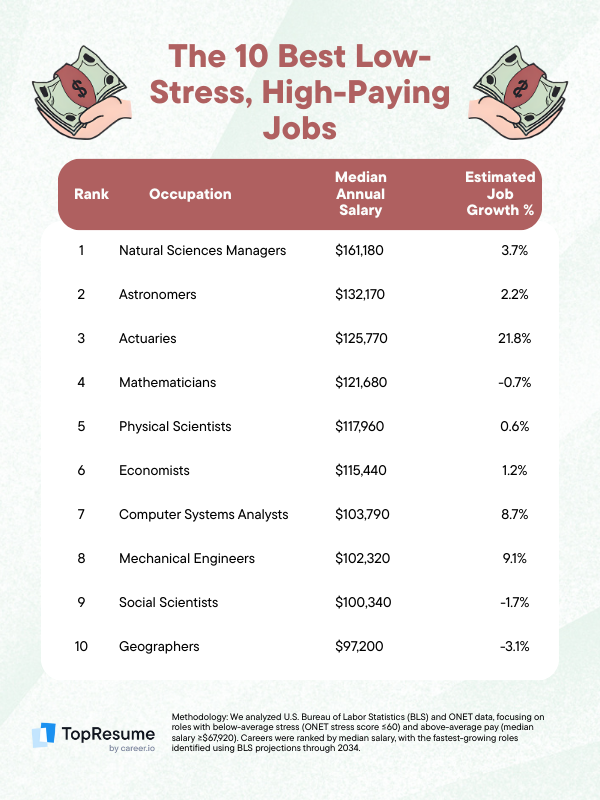
1. Natural Sciences Manager
Median Salary: $161.180
Projected Growth (2024-2034): 3.7%
Natural sciences managers oversee research and development in fields such as biology, chemistry, and physics. They manage teams, budgets, and project timelines rather than conducting hands-on experiments.
Why it’s low-stress: The role is focused on coordination and planning, rather than high-pressure experimentation. Work environments are typically structured, well-funded, and stable.
2. Astronomer
Median Salary: $132,170
Projected Growth (2024-2034): 2.2%
Astronomers study celestial objects and phenomena, analyzing data from telescopes and satellites to better understand the universe. Most work in research institutions, universities, or government agencies.
Why it’s low-stress: Research often follows long-term timelines with minimal urgent deadlines. Much of the work involves independent analysis and contemplation rather than high-stakes collaboration.
3. Actuary
Median Salary: $125,770
Projected Growth (2024-2034): 21.8%
Actuaries assess financial risk using mathematics, statistics, and data analysis, primarily in insurance and finance.
Why it’s low-stress: Their work is analytical and desk-based, often with predictable patterns. While deadlines do exist, they’re typically planned well in advance, creating a steady, structured pace.
4. Mathematician
Median Salary: $121,680
Projected Growth (2024-2034): -0.7%
Mathematicians use advanced mathematics to develop theories, solve practical problems, and conduct research in government, private industry, or academia.
Why it’s low-stress: The role prioritizes deep focus and intellectual problem-solving over rapid decision-making or interpersonal pressure, resulting in minimal stress.
5. Physical Scientist
Median Salary: $117,960
Projected Growth (2024-2034): 0.6%
Physical scientists study the natural laws governing matter and energy, including physicists and related specialists.
Why it’s low-stress: These roles are research-driven, offering intellectual autonomy and long project timelines within stable institutions.
6. Economist
Median Salary: $115,440
Projected Growth (2024-2034): 1.2%
Economists analyze data to understand economic trends, forecast outcomes, and inform policy or business decisions.
Why it’s low-stress: Most economists work in research or policy analysis roles with manageable deadlines and intellectual focus. Government and academic positions offer particularly stable environments.
7. Computer Systems Analyst
Median Salary: $103,790
Projected Growth (2024-2034): 8.7%
Computer systems analysts study an organization's current computer systems and design solutions to help the organization operate more efficiently.
Why it’s low-stress: Their work focuses on planning and analysis rather than emergency troubleshooting. Projects often follow structured methodologies with clear phases.
8. Mechanical Engineer
Median Salary: $102,320
Projected Growth (2024-2034): 9.1%
Mechanical engineers design, develop, and test mechanical devices, including engines, machines, and tools.
Why it’s low-stress: Most mechanical engineers work in structured design and development phases with established engineering processes. Emergencies are rare compared to other engineering disciplines.
9. Social Scientist
Median Salary: $100,340
Projected Growth (2024-2034): -1.7%
Social scientists study human behavior and societal trends, conducting research in fields like sociology, anthropology, and political science.
Why it’s low-stress: It is research-driven work with academic or institutional backing. Projects typically span months or years with minimal day-to-day pressure.
10. Geographer
Median Salary: $97,200
Projected Growth (2024-2034): -3.1%
Geographers study Earth's land, features, and inhabitants, analyzing spatial data to understand environmental and human patterns.
Why it’s low-stress: The work is largely analytical and office-based, with planned fieldwork and few urgent demands.
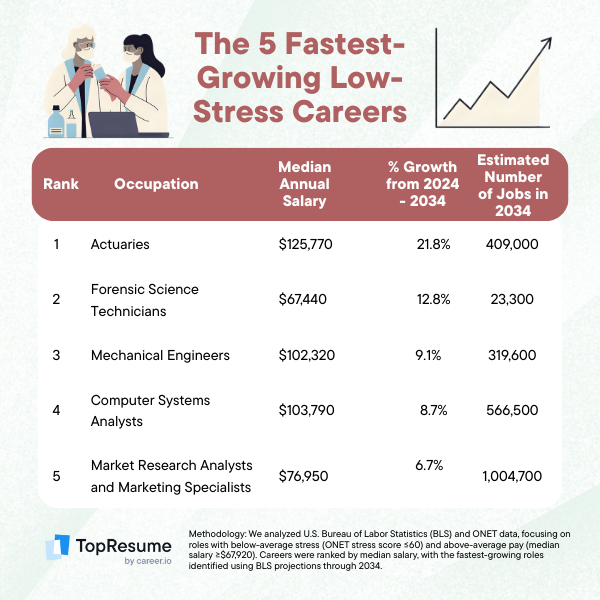
The Fastest-Growing Low-Stress Careers
While all 10 roles offer stability, these five stand out for their strong growth projections. They combine high pay, manageable stress, and long-term stability opportunities in today’s turbulent job market.
What These Careers Have in Common
When closely analyzing the top 10 careers, it’s clear that some patterns emerge as to why these jobs deliver both impressive salaries and manageable stress:
- Specialized knowledge creates value: Nearly all of these positions require advanced education or technical expertise. These barriers to entry support higher salaries while reducing competition and workplace pressure.
- Analysis over crisis management: These roles emphasize research, planning, and systems thinking rather than constant firefighting.
- Predictable environments: Whether in laboratories, offices, or research institutions, each of these careers offers structure and routine rather than constant surprises or shifting priorities.
- Intellectual autonomy: Professionals in these roles often work independently on complex problems, providing deep satisfaction without the stress of constant collaboration or micromanagement.
- Institutional stability: Government agencies, universities, and established corporations employ most of these professionals, offering job security, clear advancement paths, and comprehensive benefits.
- Long-term thinking: These careers reward patience and depth over speed and multitasking, allowing professionals to focus without the anxiety of constant context-switching.
The Bottom Line
The idea that you must choose between high salary potential and manageable stress levels is quickly becoming outdated. These roles show that with the right mix of skills, planning, and positioning, it’s possible to build a career that delivers both financial security and a healthy work-life balance.
Whether you're a student exploring potential majors or career paths, a professional considering a career change, or someone simply considering what's possible, these opportunities demonstrate that burnout isn't necessarily the price of a six-figure salary.
Low-stress, high-paying jobs aren’t a myth: they exist. The real differentiator is preparation: developing the specialized skills and experience employers are actively seeking.
However, identifying the opportunity is only half the equation. Standing out in a competitive market requires being able to clearly communicate your value. TopResume’s professional resume writers help translate your analytical strengths, technical expertise, and experience into applications that resonate with hiring managers.
TopResume’s Job Placement Service, #GetHiredNow, offers job seekers access to expert resume writing, interview coaching, LinkedIn optimization, and career guidance designed to support confident, intentional moves into roles that offer both peace of mind and long-term earning potential.
In a job market where stress often feels unavoidable, the right strategy and the right support can help turn ambition into balance and potential into progress.
Methodology
For this research, we analyzed numerous sources, including the U.S. Bureau of Labor Statistics (BLS) Occupational Outlook Handbook and O*NET's comprehensive Stress Tolerance assessments.
We set a minimum median annual salary of $67,920, the current U.S. national average according to the BLS, to ensure that every career on our list offers above-average compensation. Using O*NET's stress tolerance ratings, we focused exclusively on occupations scoring 60 or below, indicating lower-than-average workplace stress levels.
From there, we ranked the top earners by median salary and conducted a secondary analysis to identify the five fastest-growing roles based on BLS projections through 2034.

Written by
Bethany Watson is a Digital PR Manager at TopResume, where she leverages her seven years of experience in professional communications to develop partnerships with industry professionals and provide the best career resources and opportunities for job seekers.