
RTO Mandates One Year Later: What Managers Really See
Book a Free Consultation5 min read. Published on February 27, 2026

Bethany Watson

Nearly one in five managers lost team members to return-to-office mandates, with only 6% reporting genuine team support even a year later. These findings expose ongoing fallout where RTO policies have created talent crises, productivity losses, and visibility-based performance cultures. Over a third say hiring has become harder, while structural barriers like commuting costs and flexibility preferences fuel continued resistance, revealing RTO as an unresolved experiment with mounting operational and cultural costs.
Return-to-office (RTO) mandates have reshaped the modern workplace in the wake of the pandemic. While employee resistance has been widely documented, far less attention has been paid to how these policies have affected leaders.
Our previous research explored why employees remain hesitant about returning to the office, including concerns about work-life balance and flexibility. Now, new data reveals that leaders are grappling with the operational, cultural, and productivity consequences of these mandates.
From recruitment challenges to in-office distractions impacting productivity, managers say the reality of RTO is more complex than simply bringing their teams back together. Here’s what we found:
Key findings:
- Nearly one in five managers (19.5%) reported that multiple team members either threatened to leave or ultimately resigned following the rollout of RTO requirements.
- More than a quarter of managers (25.7%) estimate that between three and five hours of productivity are lost each week to in-office distractions.
- Almost two-fifths of managers (37.3%) say RTO has made hiring harder, including 9.2% who say that it is much harder.
Employee Pushback Still Remains
For many organizations, introducing RTO mandates was not a smooth transition. Our data reveals that for some teams, the resistance hasn’t faded even a year later.
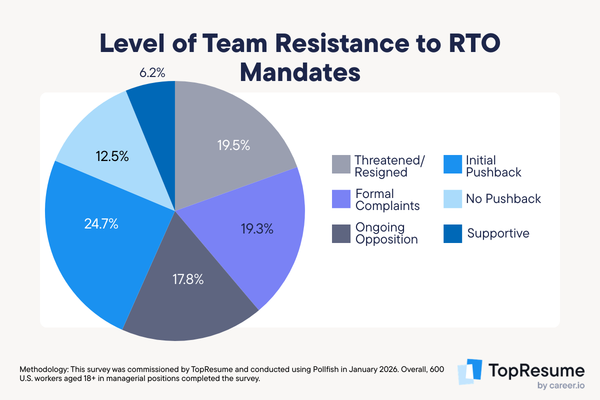
Nearly one in five managers (19.5%) reported that multiple team members either threatened to leave or ultimately resigned following the rollout of RTO mandates. Another 19.3% said formal complaints or structured pushback were submitted, while 17.8% described ongoing vocal opposition within their teams. One year later, the fallout from these mandates is still reverberating across organizations.
Perhaps most surprising, only 12.5% of managers noted no significant pushback, and only 6.2% said that their teams were genuinely supportive of the shift.
The Real Barriers Keeping Employees at Home
Managers also highlighted the significant barriers preventing their teams from fully embracing the shift back to the office.
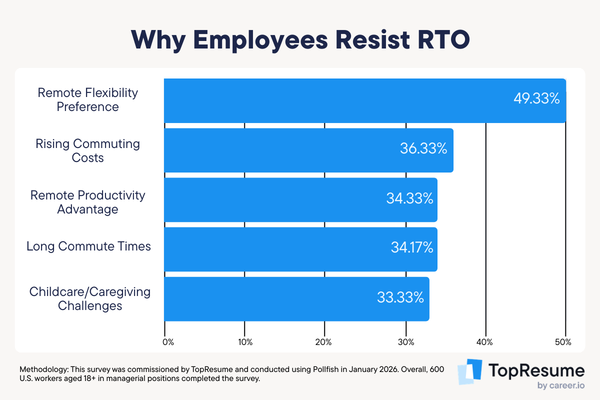
Nearly half (49.3%) say employees prefer the flexibility of working from home, while rising commuting costs (36.3%), perceived productivity advantages of remote working (34.3%), long commute times (34.2%), and childcare or caregiving challenges (33.3%) remain major obstacles.
Taken as a whole, these factors suggest that resistance to RTO isn’t simply cultural – it’s structural.
RTO Is Creating a Talent Crisis
For many teams across the U.S., RTO has also become a talent issue that’s affecting both retention and recruitment.
A quarter of managers (25%) say they’ve lost team members within the last six months alone due to increasing RTO requirements, while another 23.8% report losses within the last year. Another tenth (10%) of managers say that they have lost team members over a year ago. Only around one-third (30.3%) say they haven’t lost any employees linked to the policy.
Recruitment is proving difficult too. Over a third of managers (37.3%) say RTO has made hiring harder, including 9.2% who say that it is much harder.
These findings reveal that as organizations compete for skilled professionals in a market where flexibility remains highly valued, rigid office policies may be narrowing candidate pools.
In-Office Distractions Are Costing Hours of Productivity
The survey also revealed that the promise of in-office team collaboration is hindered by day-to-day office interruptions.
Nearly a third of managers (31.2%) say their teams experience frequent interruptions during in-office days, occurring two to three times per week. Another 27.5% report interruptions happening weekly, while a staggering 14.5% say disruptions occur nearly every day employees are in the office.
These interruptions aren’t trivial. A quarter of managers (25.7%) estimate that between three and five hours of productivity are lost each week to in-office distractions such as off-topic conversations, noise, or unplanned interruptions. Others report even greater losses, with 15.7% estimating up to 15 hours lost and 7.5% saying more than 16 hours per week are impacted.
The Visibility Trap
One unexpected consequence of RTO is a shift in how performance is measured by management.
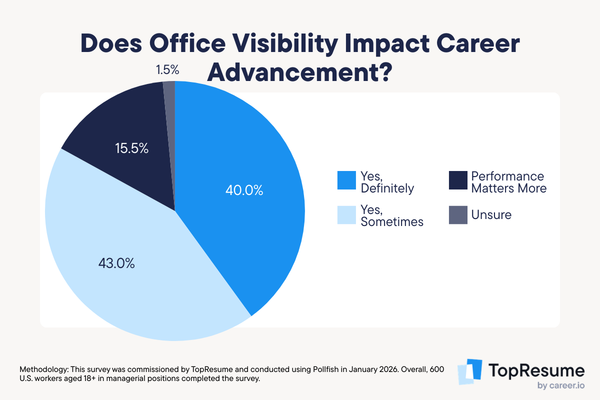
Two in five managers (40%) believe that office visibility definitely influences career advancement more than actual performance, with another 43% saying that it sometimes does. Only 15.5% feel performance outweighs visibility in career advancement.
Unsurprisingly, this perception has fueled some behavioral changes. Nearly half of managers (47%) say that they have occasionally observed employees appearing busy rather than being genuinely productive – a phenomenon career.io coined as “task masking.” An additional quarter (23.8%) reports observing it frequently.
What Managers Say Are the Biggest RTO Challenges
When asked about the biggest downsides of RTO, managers pointed to several recurring themes:
- Reduced flexibility for employees (15.7%)
- Higher employee turnover (15.2%)
- Increased management complexity (14.7%)
- More workplace distractions and interruptions (12.8%)
- Higher operational costs (10.5%)
These challenges highlight a key tension: while companies may view in-office work as a strategic necessity, managers are navigating the practical trade-offs.
Conclusion
While our previous research focused on how employees feel returning to the office, these new insights reveal how the transition is reshaping leadership challenges, even one year later.
Managers aren’t just enforcing attendance; they’re balancing productivity with morale, retention, and changing expectations around visibility and performance.
The reality is clear: RTO mandates may be less of a final destination and more of an ongoing experiment – one that organizations are still learning to manage effectively.
What we did
This survey was commissioned by TopResume and conducted using Pollfish on January 30, 2026. Overall, 600 U.S. workers aged 18+ in managerial positions completed the survey.

Written by
Bethany Watson is a Digital PR Manager at TopResume, where she leverages her seven years of experience in professional communications to develop partnerships with industry professionals and provide the best career resources and opportunities for job seekers.